


IoT-Enabled Rural Water Supply Scheme in Punjai Palatholuvu Panchayat, Erode District.
Funding Agency: Severn Glocon Valves Private Limited.
Location: Punjai Palatholuvu Panchayat, Erode District.
Coordinators: Prof. Ligy Philip Prof. Sridharakumar Narasimhan, Prof. S. Srinivasan and Prof. B. S. Murty
The IoT-based Smart Water Management System implemented in Punjai Palatholuvu Panchayat, Erode District, transformed the existing rural water supply scheme into a digitally monitored, automated, and user-centric system. the intervention addressed irregular supply, water quality concerns, manual dependency, wastage, and limited accountability. IoT-enabled sensors, automated pumps, actuated control valves, cloud-based monitoring, and a mobile alert platform were integrated for efficient system management. Real-time monitoring of turbidity, TDS, pH, and residual chlorine at the Overhead Tank and distribution points enabled continuous water quality assessment. Automated chlorination maintained residual chlorine at 0.1–0.4 mg/L, ensuring reliable disinfection.
The project was financially supported by M/s Severn Glocon Valves Pvt. Ltd. (SGVPL). AquaMAP provided the design, guidance and coordination. Real Tech Systems were the field implementation partners.
Social surveys conducted before and after implementation demonstrated significant improvements. The IoT-based water management system significantly improved the reliability, consistency, and equity of water supply through automated scheduling and controlled distribution. Real-time monitoring and automated chlorination ensured safe drinking water by maintaining appropriate residual chlorine levels, while optimized valve operation and regulated supply duration reduced water wastage. Automation of pumps, valves, and dosing systems minimized manual intervention, operational errors, and manpower dependency,
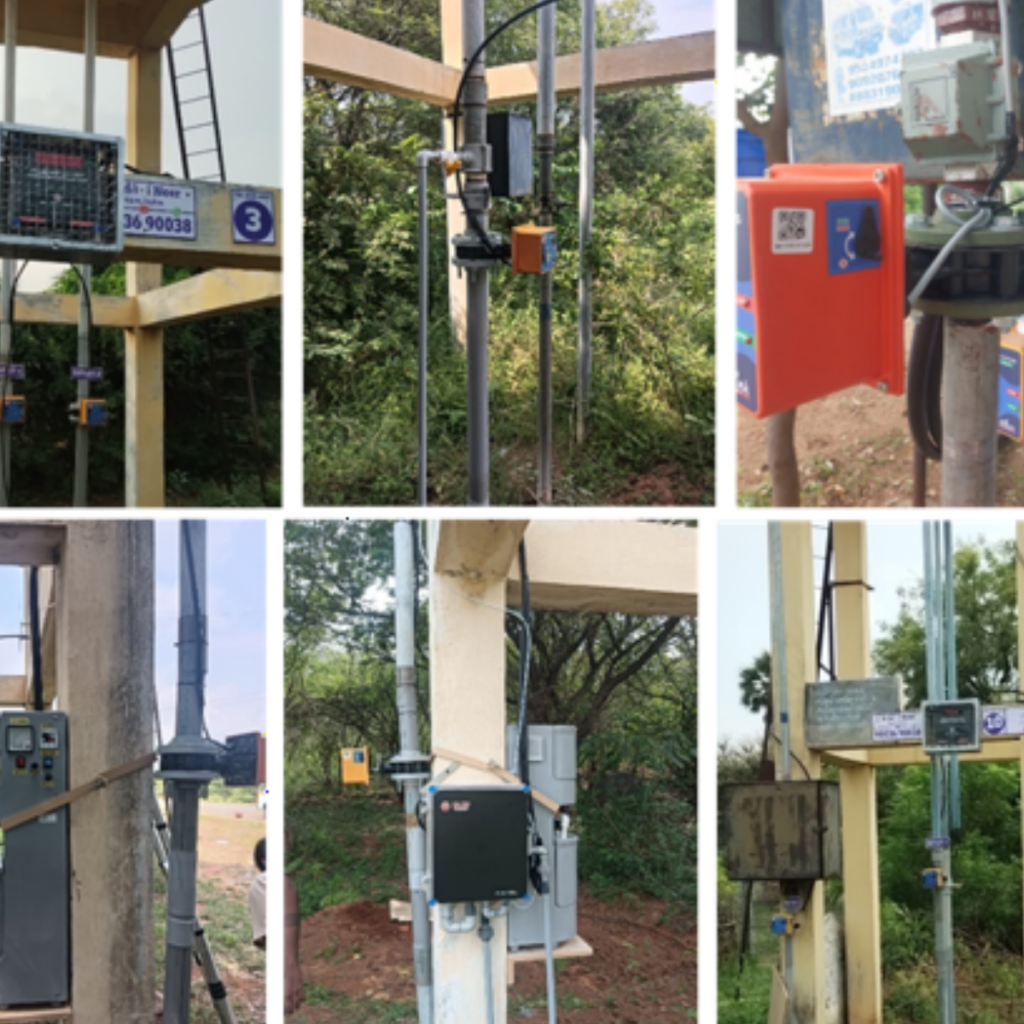
while optimized pumping and solar-powered backup improved energy efficiency and system continuity. The intervention also generated time savings for households, particularly women, by reducing uncertainty and the need to wait for or seek alternative water sources, thereby supporting greater opportunities for employment. The consumer alert mechanism enhanced transparency by providing advance notifications on water supply start and stop times, enabling better household planning. Efficient system management also contributed to reduced operational and maintenance costs. Overall, the intervention increased user satisfaction, trust in water quality, and public health protection. Notably, 98% of households now directly consume the supplied water without additional treatment, demonstrating increased confidence in water safety.
A population of 258 persons, spread over 17 villages and 867 households are directly benefited.
The project demonstrates a scalable and sustainable model for rural water management, integrating automation, real-time data, efficient resource utilization, and community engagement to deliver reliable, safe, equitable, and accountable water services.